PROJECT OVERVIEW 🚀
This was a term project for a class called Human Factors and Technology at Cal Poly. The class was split into teams and assigned a human factors related topic, and then tasked with identifying a human factors related problem in that space and proposing a solution. for it.
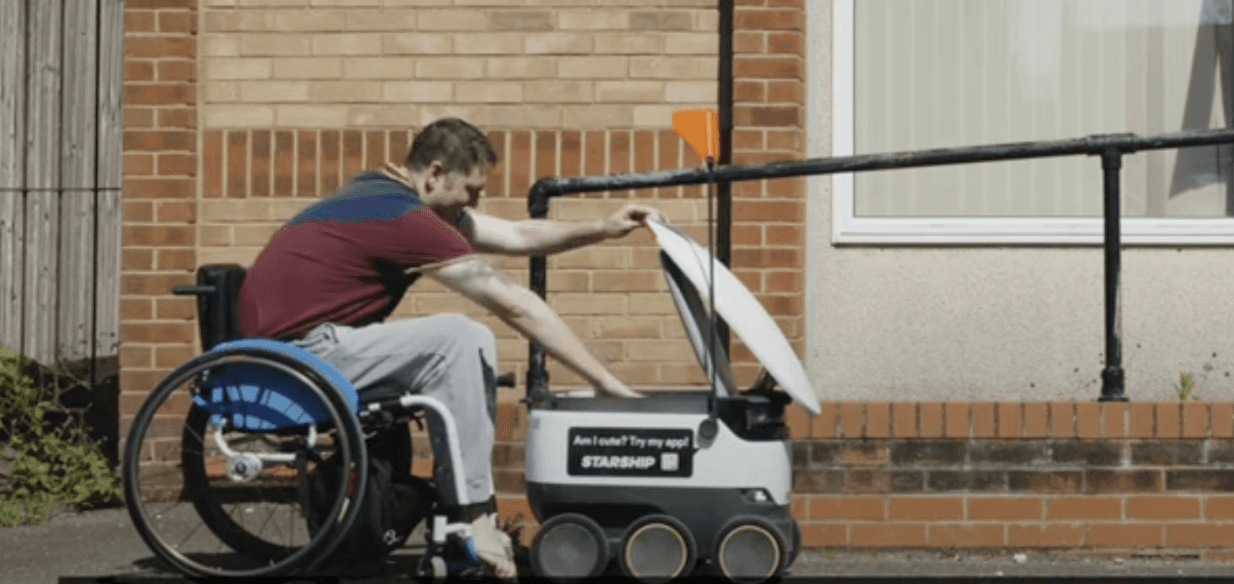
My team was assigned robotics, and we chose to focus on autonomous delivery robots (A.D.R.s) The problem we identified was that people in wheelchairs had to lean over awkwardly in order to pick up the robot's contents.
PROBLEM 🎯
Lifting something upward while bent over at an angle puts strain on the person's neck.
SOLUTION 🧠
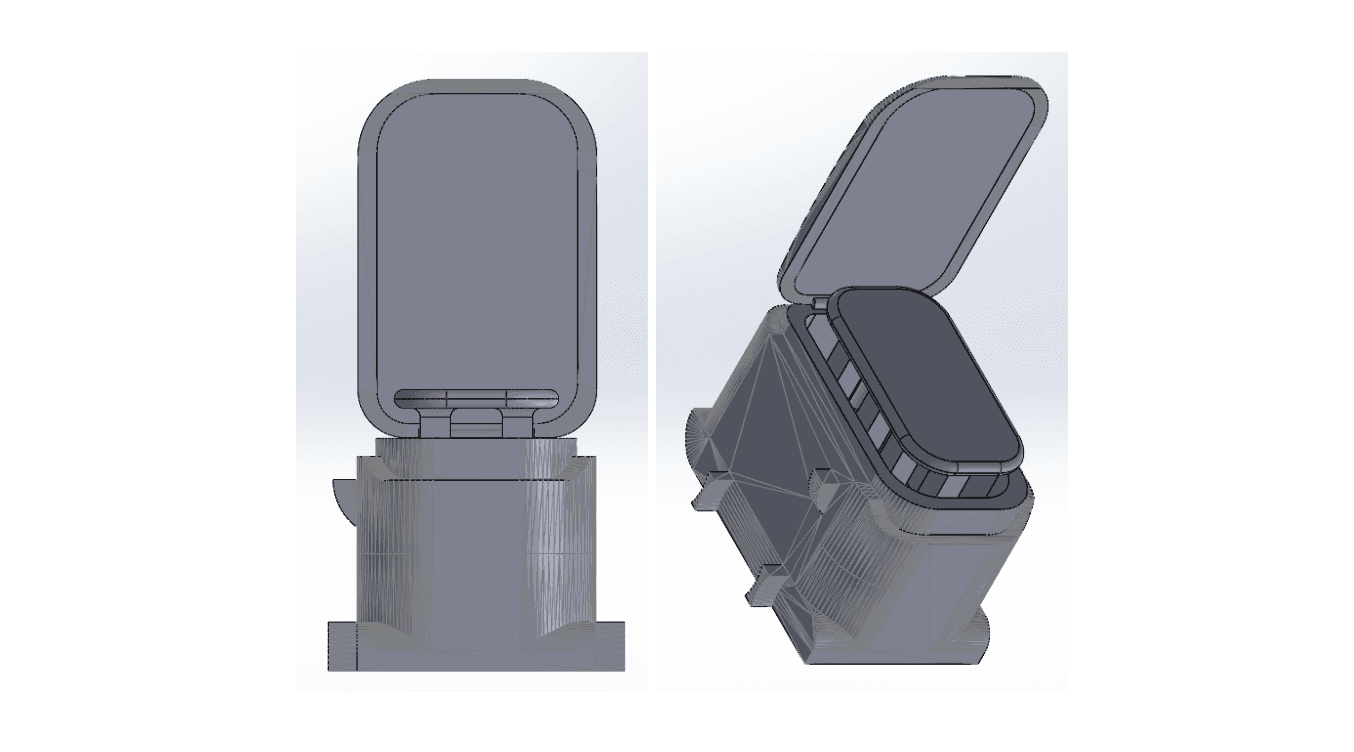
We designed a mechanism that could raise the contents of the ADR towards the user, allowing them to pick up the contents without leaning over as much.
1. SURVEYS ✏️
Once we had identified the problem we were trying to solve, we started looking for insight that would lead us to our final solution.
We sent out a Google Form to everyone in the class and asked them to share some ideas for potential features and any experience they had with using ADRs.
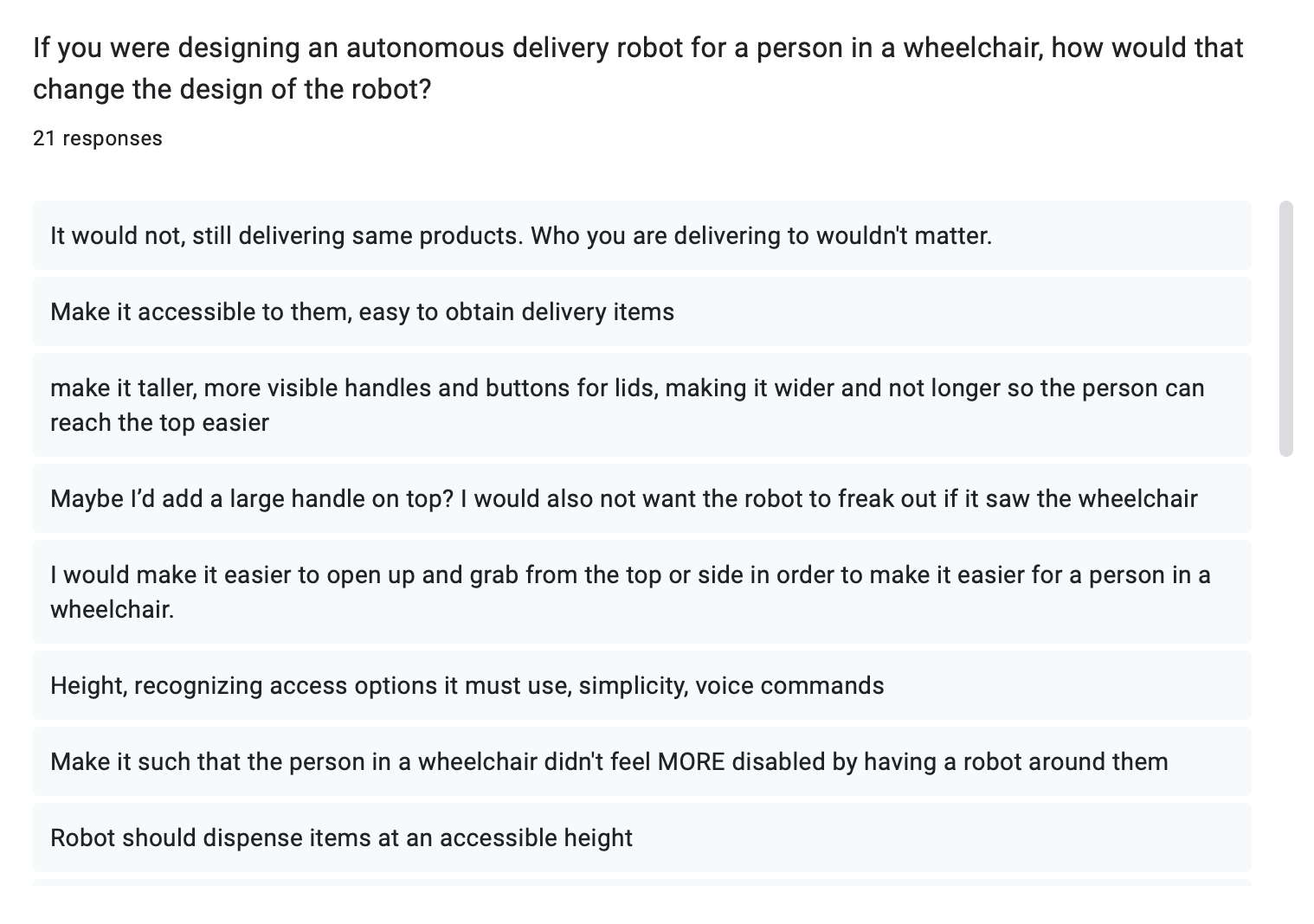
A few of the responses mentioned height, which led us in the direction of some kind of mechanism to raise the contents upward out of the ADR.
With that in mind, we set out to determine the proper dimensions of the raising mechanism.
ANTHROPOMETRIC STUDY 🙋♀️
In order to approximate the human dimensions that the mechanism would need to accommodate for, we conducted an anthropometric study with our classmates.
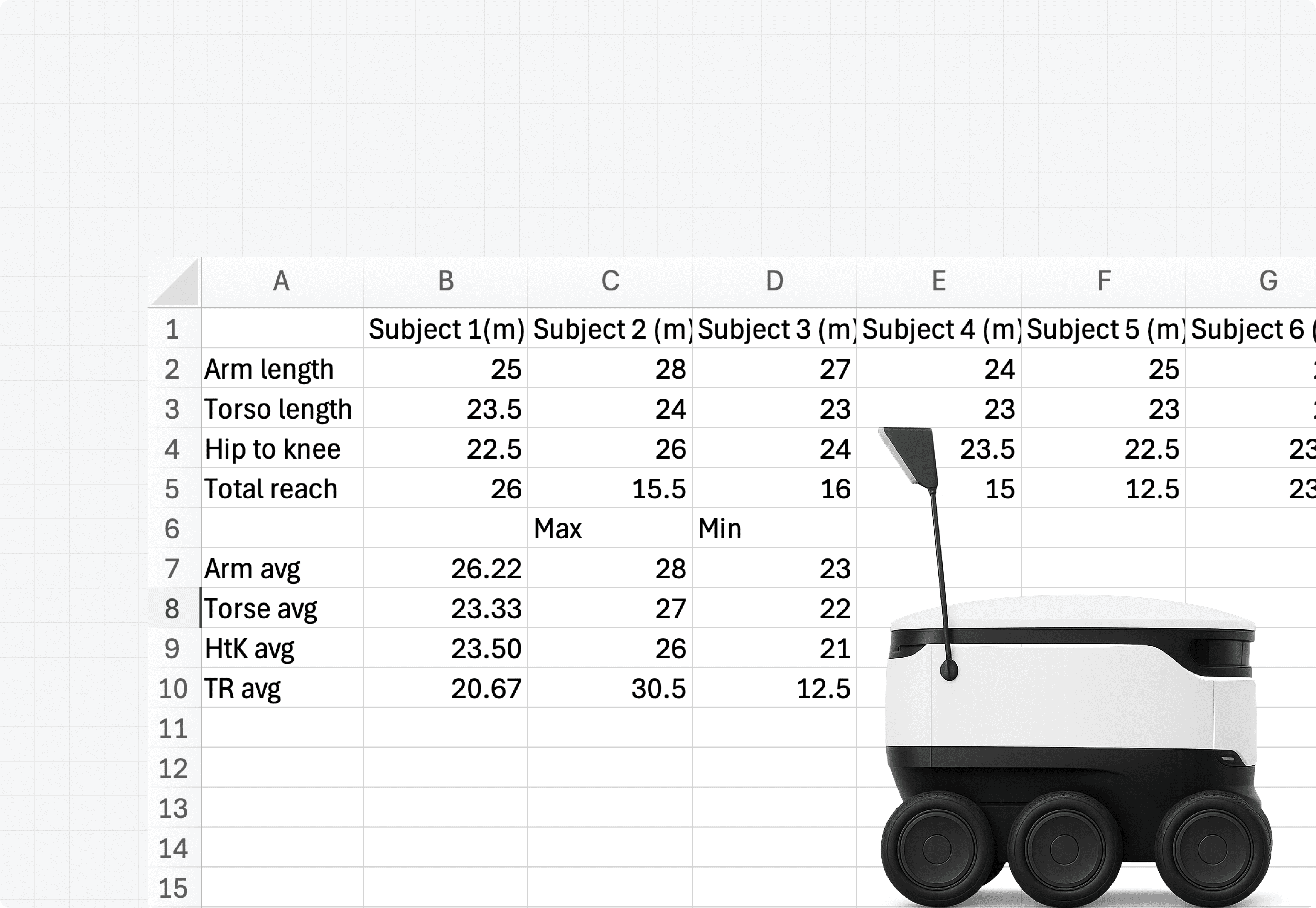
We had 18 people (both males and females) participate, and we took four key measurements: arm length, torso length, hip to knee length, and total reach.
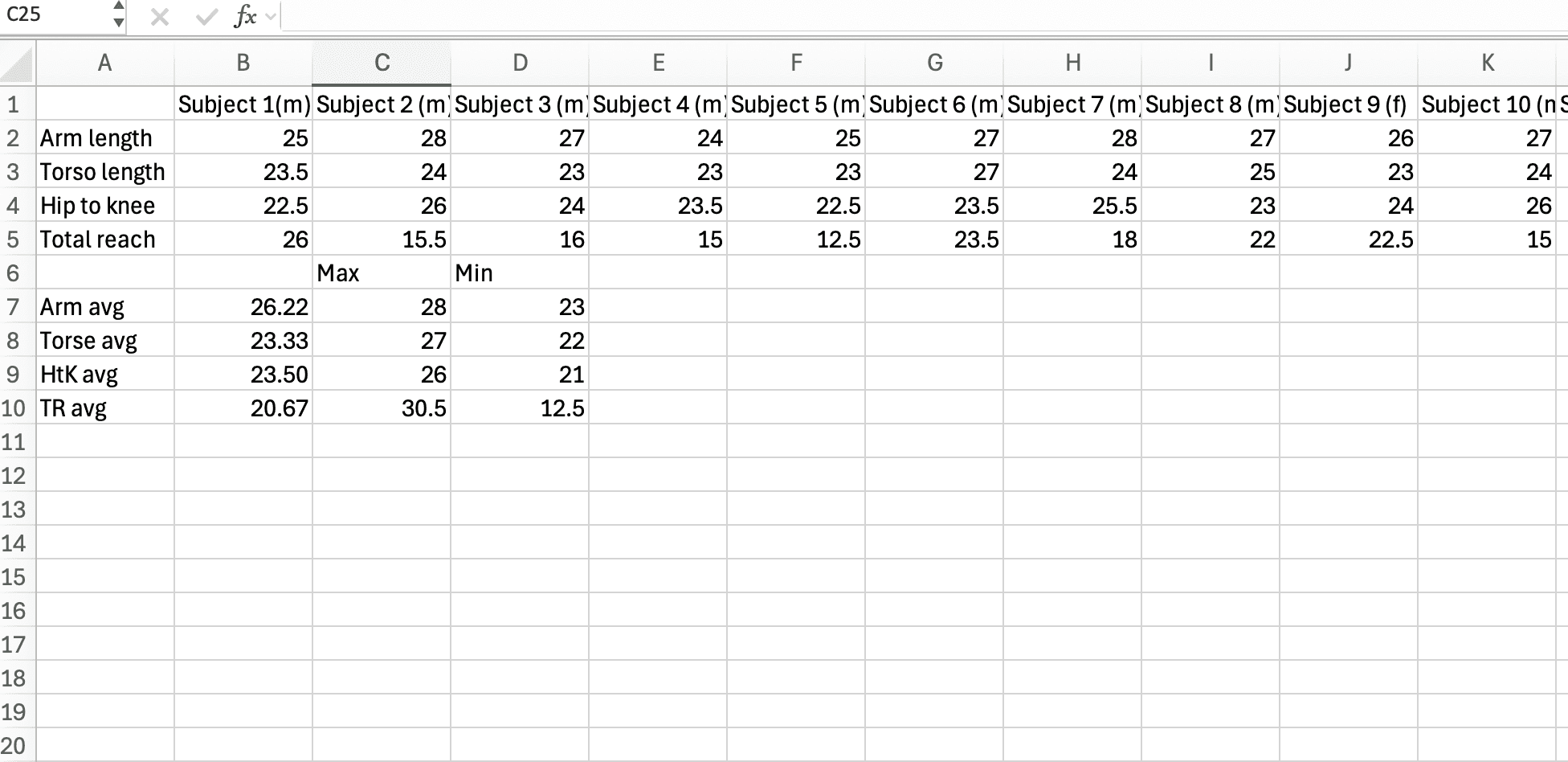
The total reach measurement was taken by having participants sit on a chair in order to simulate being in a wheelchair and reaching forward as far as they could while remaining seated.
3. DATA ANALYSIS 📊
The averages for arm length, torso length, hip to knee length, and total reach were were 26.22in, 23.33in, 23.50in, and 20.67in, respectively.
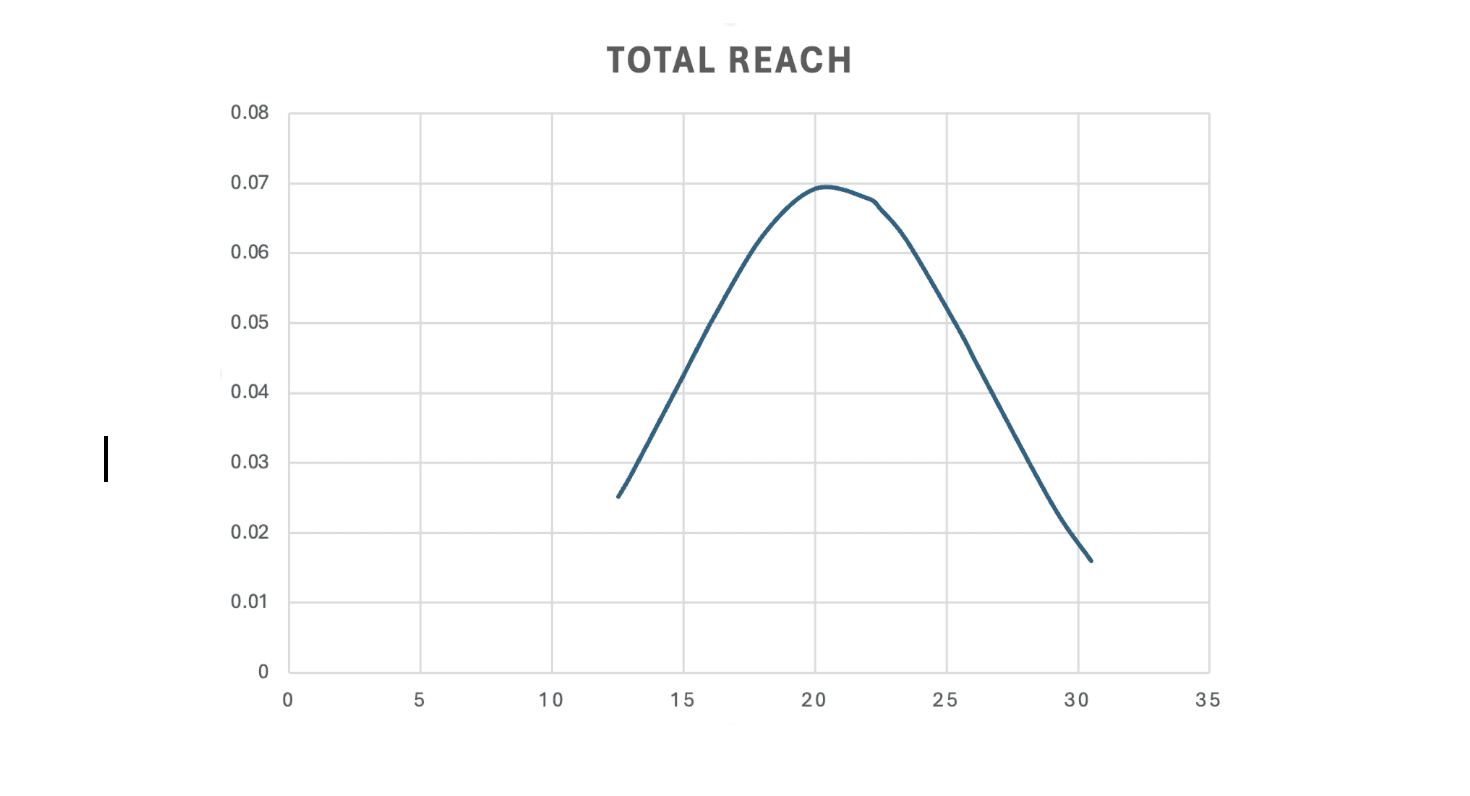
We were primarily concerned about total reach, so we made a bell curve for this metric. The high and low extremes were 30.5in and 12.5in respectively.
We also found a positive correlation between total reach and arm length.
4. APPLYING THE DATA 🧍♂️
The final step in the design process was to apply the data to determine how high the mechanism should be able to be raised and if it would have any kind of significant effect.
Through some additional research, we were able to uncover the dimensions of typical ADRs as well as some formulas that let us approximate the minimum height the mechanism should be able to be raised, in addition to the effect of doing so.
We used the following dimensions guide from dimensions.com:

We made the following assumptions:
The robot cargo access point is at the top of the robot, approximately 21.8 in above the ground.
Wheelchair seat height is assumed to be 19 in above the ground.
Torso measurements were treated as seated torso height from seat surface to shoulder level.The mechanism raises the contents vertically only, not horizontally toward the user.
The object is assumed to be reachable at the near edge of the robot opening.
Important Note 🚨: For the rest of this analysis, we'll be focusing on a user who fits the low extreme group since the low extreme in this context represents users that are more constrained.
Step 1: Convert Torso Length Into Shoulder Height
In order to calculate the minimum raise height required, it makes more sense to convert torso length into shoulder height from the ground.
For the low extreme, the torso length was 22in, and the seat height is 19in. That gives us a shoulder height of 41 in.
Step 2: Calculate Raise Needed to Reach
For a person from the low extreme group to reach the item without moving their shoulder forward, the distance from shoulder to item must be less than or equal to arm length:
(D^2 + (S-H)^2)^1/2 ≤ A or H ≥ S - (A^2-D^2)^1/2
Where:
D = horizontal distance caused by hip-to-knee length
S = shoulder height above ground
H = item pickup height
A = arm length
Solving for the low extreme group, where shoulder height is 41in, hip to knee distance is 21in, and arm length is 23in, the minimum height off the ground the mechanism would need to be in order to be reachable would be 31.6in.
31.6in-21.8in for the height of the robot leaves 9.8in as the lift required to achieve this height.
Step 3: Calculate the Maximum Height the Mechanism Should be Able to be Raised
For lower strain, the item should ideally be raised closer to the user’s seated shoulder/chest area, rather than merely barely reachable.
The lift height from the top of the robot to the shoulder of someone from the low extreme group would be the shoulder height minus the robot height, so 41-21.8=19.2in.
Step 4: Calculate Stress Reduction
Since we didn't have access to data about neck angle, user strength, weight of the contents, etc. during the study, it is impossible to calculate exact stress reduction.
However, the reduction in required straight-line reach distance for the low-extreme user can be calculated instead.
For the low extreme user, the straight-line reach distance is 28.45in from their shoulder to the top of the robot (calculated using the distance formula). When the contents are raised to 21in, the straight-line reach distance also becomes 21in.
Therefore, using the percent decrease formula, the new design should decrease effort/reach-related loading by 26%.
5. LIMITATIONS AND NEXT STEPS 👟
There were definitely some noteworthy limitations with our findings. For one, the sample was a convenience sample and is likely not representative of the entire population of potential users.
Another major limitation was that we didn't actually have the chance to speak with any wheelchair users. It would have been great to get some feedback on how they navigate ergonomic problems like this and if they would have approached the problem any differently.
When it comes to the calculations, we did the best with what we had, but we could have come to more precise and potentially more valuable conclusions if we had data on the actual force exerted on the neck from holding the contents, neck angle, trunk angle, posture, and so on.
This might have allowed us to make a claim about how much force was reduced using the mechanism vs simply how much effort was reduced.
If we were to give this problem the full attention it deserves and we weren't limited by the lack of time and resources from it being just a class project, or if future researchers were to pick this up, we would do a number of things differently:
Talk to real wheelchair users
Employ random sampling in order to get a representative sample or consult publicly available anthropometric data on the population of the U.S.
Consider additional metrics like the ones listed above in order to come to more precise conclusions
Evaluate the feasibility of making the mechanism extendible in the horizontal direction as well
Fin.